Your local, professional, and reliable partner for all your tree service needs.
Contact Info
Your local, professional, and reliable partner for all your tree service needs.
Contact Info
Your tree might be telling you something's wrong. Learn the seven critical warning signs that mean it's time to call a professional tree service in Cherokee, GA. Because trees don't send a "heads up" text.
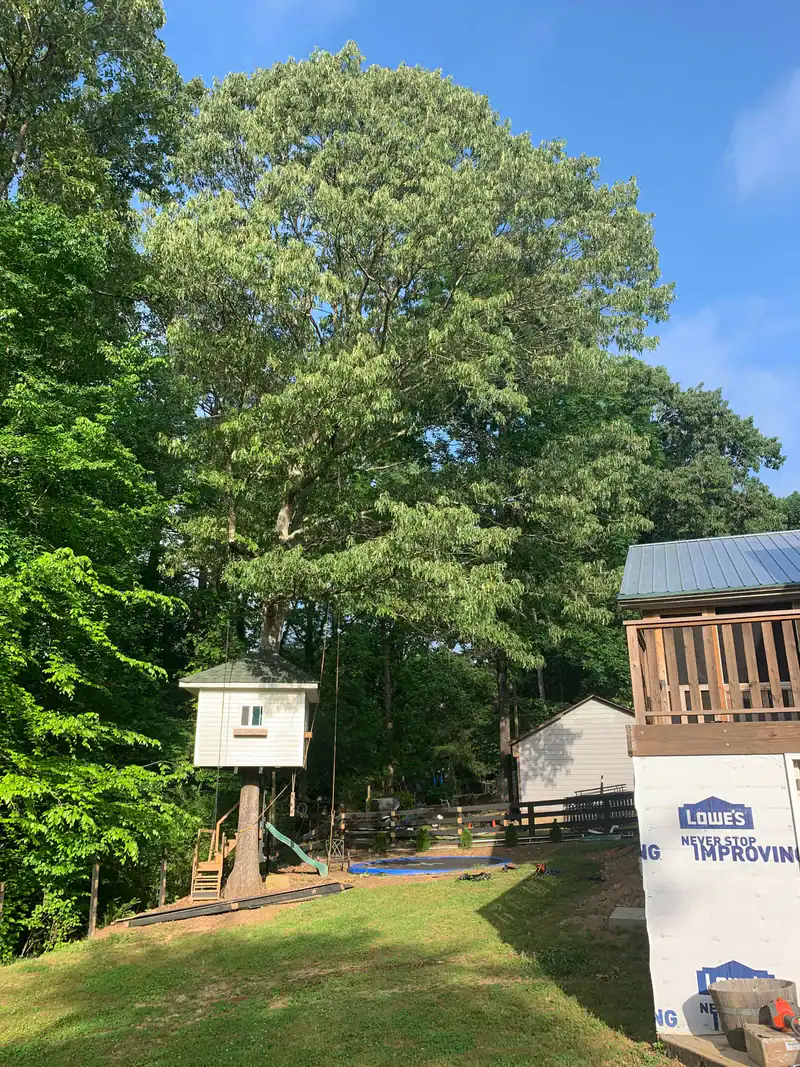
Trees don’t just fall over because they’re bored. Something weakens them first—disease, root damage, storm trauma, or just the tree equivalent of a mid-life crisis. The problem is that trees are incredibly good at “faking it until they make it” (or break it) until they finally give up. A tree can look perfectly fine from your driveway but be as hollow as a politician’s promise on the inside. It can stand tall for months with a root system that’s basically holding on by a thread. That’s why being a “tree whisperer” is less about talking to them and more about noticing when they’re screaming for help.
The warning signs fall into a few categories: structural damage, decay, root problems, and “it’s too close to the power lines” issues. Some of these mean you need emergency tree removal today. Others just mean your tree needs a spa day. Either way, ignoring them won’t make the problem go away—it just makes the eventual bill look a lot more like a mortgage payment.

If your tree has always leaned a bit, that’s probably just its personality. Some trees grow at an angle because they’re overachievers looking for more sun. But if a tree that used to stand straight is suddenly leaning—especially after a Georgia gully-washer—that’s the tree equivalent of a “Mayday” call.
When roots get damaged or the soil becomes a swamp, trees lose their anchor. You might notice the ground on one side is heaving or cracking like it’s trying to swallow the lawn. That’s the rootball shifting, and once gravity takes the lead, gravity doesn’t lose. A lean of more than 15 degrees is a hazard, but let’s be real: if you’re looking at a tree and thinking “I don’t remember it being that close to the mailbox,” put the protractor away and call a pro. Cherokee’s clay soil makes this worse; it gets waterlogged, and trees with shallow roots essentially “ice skate” right out of the ground. Don’t wait for the next storm to see if your tree can handle the wind—gravity is a patient but persistent stalker.
Dead branches are called “widowmakers” in the industry. If that name doesn’t make you want to wear a helmet in your own backyard, nothing will. A branch that’s dead has zero grip strength; it’s just a matter of time before wind, ice, or a particularly heavy squirrel brings it down.
One or two small twigs aren’t a crisis—trees shed like Huskies. But if you’re seeing multiple large dead limbs, or if 25% of the canopy looks like a prop from a horror movie, the tree is in trouble. It’s either diseased, stressed, or just done.
The real danger is the “target zone.” A dead branch over your driveway means a very awkward insurance claim for your car. Over your roof means you might be sleeping under the stars (literally). And for the love of all things holy, do not try to handle this yourself with a ladder and a chainsaw. That is the fastest way to end up as a viral video on “What Not To Do.” Professional tree services have insurance and specialized gear because they know that branches don’t always fall where you ask them to.
Want live answers?
Connect with a Tree Service 4 U expert for fast, friendly support.
The trunk is the tree’s backbone. When it’s compromised, the whole thing is a liability. Vertical cracks or deep seams are bad news—they indicate the tree is literally splitting under its own weight. If you can see daylight through a crack, the tree is essentially a giant Jenga tower waiting for someone to pull the wrong block.
Cavities and hollow sections are trickier. Some trees are survivors and can live for years with a hollow core, but if more than a third of the trunk is gone, it’s a structural nightmare. It might look fine on a sunny Tuesday, but a 40-mph wind gust will turn that hollow trunk into a pile of kindling faster than you can say “Timber!”

If you see mushrooms growing on the trunk, that isn’t a sign of a magical forest. It’s a sign of a fungal buffet, and your tree is the main course. Fungi only show up when there’s decay to eat, so if you see mushrooms, the rot has already moved in and started decorating.
Fungal growth usually shows up as “conks” or shelf-like brackets on the bark. By the time the mushroom appears, the internal rot has been spreading for months or even years. The scary part? You can’t see the damage from the outside. A tree can look solid but be as sturdy as a wet cardboard box inside. Once the rot hits the structural layers, your tree isn’t a plant anymore; it’s a 5,000-pound hazard. Call an arborist before the tree decides to “remodel” your porch.
Roots belong in the ground. If you’re suddenly seeing roots that weren’t there before, or if the soil is “heaving” (lifting up like something is trying to escape from the underworld), you have a major instability problem.
Erosion from Georgia rain can wash away soil, but heaving soil means the tree is actively tipping. The roots are literally pulling out of their anchor points. Cherokee’s clay expands and contracts, which is already hard on roots, but a heavy canopy acting like a sail in the wind is the final straw.
If the ground is cracking around the base, that tree is preparing to lie down. This is not the time for a DIY solution like piling more dirt on top. You need an arborist to evaluate if cabling can save it or if it’s time for the stump grinder. Don’t gamble with a tree that’s trying to do a trust fall with your house.
Spotting these signs is step one. Step two is admitting you probably shouldn’t fix it with duct tape. If your tree is leaning, cracking, or growing mushrooms like a damp basement, don’t wait for “next season.” Trees don’t have calendars; they just have gravity.
Not every sign means the tree has to go. Sometimes a strategic trim or some arborist-approved TLC can save it. But guessing wrong could cost you your roof, your car, or your dignity.
If you’re seeing any of these red flags on your Cherokee, GA property, we can help. Get it looked at before the next Georgia storm makes the decision for you—because we’re much better at removing trees than we are at repairing roofs.
Summary:
Share: