Your local, professional, and reliable partner for all your tree service needs.
Contact Info
Your local, professional, and reliable partner for all your tree service needs.
Contact Info
When a tree decides to "drop in" on your Cherokee County living room, the bill shouldn't floor you. Here is your survival guide to storm recovery and insurance sanity.
Here is the “trunk” of the matter: insurance doesn’t cover every tree that takes a nap on your lawn. If a tree falls in the forest and no one is around, does it make a sound? Maybe. But if a tree falls in your yard and doesn’t hit anything, does insurance pay for it? Usually, no.
Your policy typically kicks in when a tree falls due to a “covered peril”—the insurance version of an “act of God,” like wind, lightning, or that ice storm that turned your driveway into an Olympic skating rink. Crucially, it has to hit an insured structure. This means your house, garage, or even that “she-shed” you spent all summer building. If the tree lands gracefully on your grass without scuffing a single shingle, the insurance company will likely tell you, “Nice tree, your problem.”
There’s also the “Health Inspector” hurdle. If your tree was visibly dead, rotting, or leaning at a 45-degree angle for three years, the adjuster might claim “negligence.” Essentially, they’ll argue you invited the disaster to dinner. However, if a perfectly healthy Georgia Pine gets suplexed by a tornado onto your roof, you’re generally in the clear for both the repairs and the removal.

Let’s talk money, because unless you’re harvesting lumber as a side hustle, this gets pricey. Most standard policies cap “debris removal” at $500 to $1,000 per tree. In the world of emergency crane work, $500 is basically a “thank you for calling” fee.
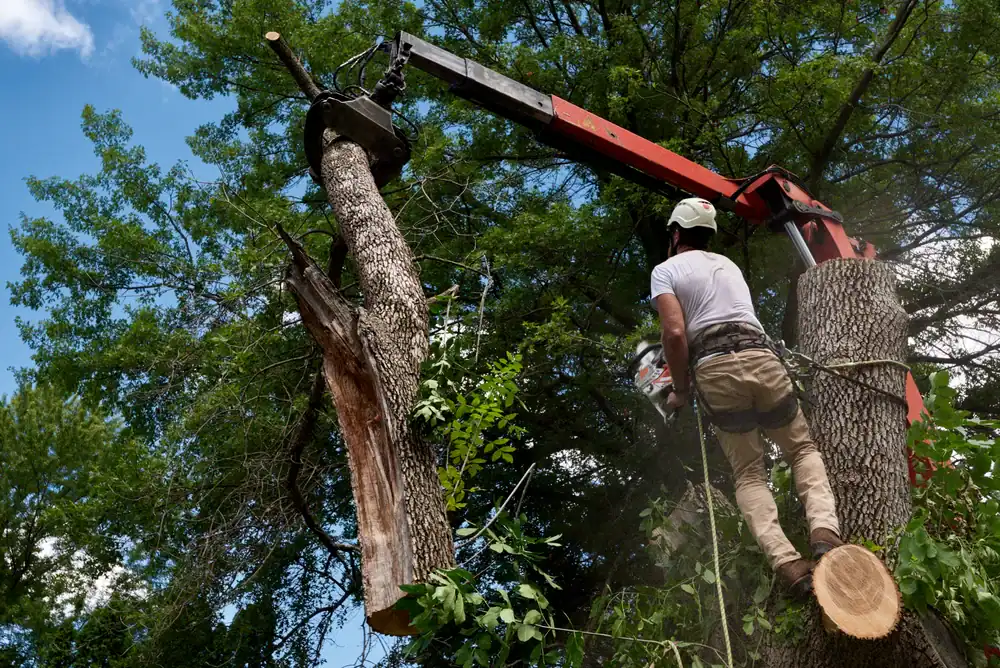
Actual emergency removal can run anywhere from $500 to $5,000. A massive oak that has decided to become a permanent resident of your master bedroom requires more than a guy with a ladder; it requires heavy machinery and surgical precision.
But don’t panic yet! There’s a loophole big enough to drive a log truck through. While “debris removal” limits are small, “dwelling coverage” limits are huge. If the tree is on the house, removing it is considered “mitigating further damage.” You aren’t just cleaning up a mess; you’re stopping the rain from turning your hardwood floors into a swimming pool. A savvy tree service knows how to categorize these costs so the insurance company pays the lion’s share, rather than leaving you to check the couch cushions for spare change.
Insurance companies aren’t in the business of landscaping. You can’t call them and say, “Hey, this oak is blocking my view of the sunset, can you pay to whack it down?” That’s preventative maintenance, and that’s on your tab.
Want live answers?
Connect with a Tree Service 4 U expert for fast, friendly support.
When the sky falls in Cherokee County, put the chainsaw down and pick the smartphone up. Your first priority is safety—stay away from downed power lines unless you’re looking for a very shocking experience. Once the area is safe, it’s time to play private investigator. 1. Document Like a Tourist: Take 50 pictures. Take a video. Capture the tree, the crushed gutters, the broken windows, and even the “I can’t believe this” look on your face. Evidence is king. 2. Call the Mothership: Contact your insurance agent immediately. Get a claim number. Write down the name of everyone you talk to—if you end up speaking to “Steve” three times, make sure it’s the same Steve. 3. Mitigate, Don’t Renovate: You have a “duty to protect” the property. This means putting a tarp over holes. It does not mean hiring a contractor to build a new wing of the house before the adjuster arrives.

The insurance adjuster’s job is to save the company money. Our job is to make sure they spend it where it’s deserved. When an adjuster shows up, they’re looking for reasons to say “no.” Having a tree service with staff adjusters is like bringing a lawyer to a deposition—it levels the playing field.
We speak “Insurance-ese.” When an adjuster says, “We’ll pay $500 for debris,” we say, “Actually, this is a high-risk structural mitigation involving a 40-ton crane to prevent total roof collapse.” Suddenly, the conversation changes. We provide the technical documentation, the “before and after” proof, and the itemized billing that makes sense to a desk adjuster in an office three states away.
The best part? We often bill the insurance company directly. This means you don’t have to watch your savings account vanish while waiting for a reimbursement check that may or may not be “in the mail.”
EMPTY_FIELD
Dealing with storm damage is enough to make anyone want to move into a cave. But in Cherokee County, you don’t have to go it alone. By acting fast, documenting the “tree-mendous” mess, and partnering with pros who understand the insurance game, you can turn a disaster into a manageable Tuesday.
The secret ingredient is working with a team that brings more than just sharp saws—they bring the expertise to navigate the paperwork. We handle the heavy lifting (literally and figuratively) so you can get back to your life.
Ready to get that oak out of your bedroom? Give us a call. We’ll handle the emergency removal, talk to your adjuster, and help you maximize your claim while you focus on more important things—like where to buy a tree-proof umbrella.
Summary:
Share: