Your local, professional, and reliable partner for all your tree service needs.
Contact Info
Your local, professional, and reliable partner for all your tree service needs.
Contact Info
Overgrown trees don't just block your view—they threaten your home, your safety, and your property value. Here's how Cherokee County homeowners are taking back their yards. Because "Lost in the Backyard" shouldn't be a true story.

Tree services cover more than just a guy with a chainsaw and a “can-do” attitude. In Cherokee County, professional services include tree removal, trimming, pruning, stump grinding, emergency storm response, and forestry mulching. Each one is a specific tool to help your yard look better than ever.
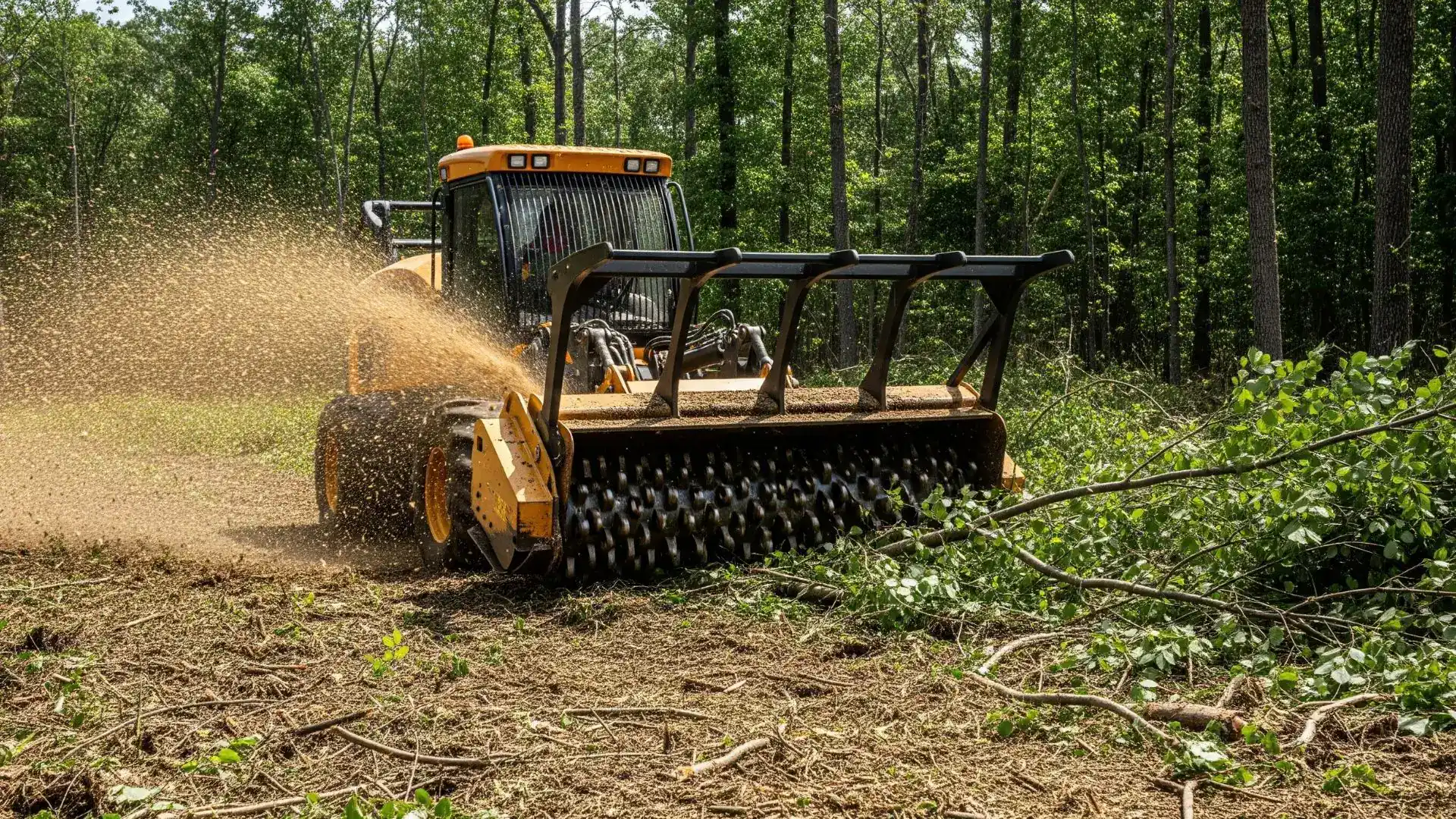
Tree removal handles the dead or dangerous “leafless wonders.” Trimming and pruning keep healthy trees from becoming unintentional roof ornaments. Stump grinding gets rid of the “lawnmower killers” left behind. Emergency services are your 3:00 AM best friends when a branch decides to visit your living room, and forestry mulching turns an overgrown jungle into a walkable space. Confirm your contractor can actually do the job before they start—hiring a mower to do a crane’s job is a recipe for a viral “what not to do” video.

Dead trees don’t have a great track record for staying upright. If your tree has dropped all its leaves while the neighbors’ are lush, or if the bark is peeling off in sheets like a bad sunburn, it’s dying. Leaving it there is basically playing a high-stakes game of “Tree Roulette.”
Storm-damaged trees are even trickier. A tree that took a lightning hit or lost major limbs might look fine, but its structure could be as stable as a house of cards. We check for cracks and root damage—the stuff you can’t see from the driveway. Sometimes it’s not even about disease; it’s about the tree being a “bad neighbor” to your foundation or septic system.
In Georgia, you usually don’t need a permit for your own property unless it’s a “Heritage Tree,” but you do need a professional. The process involves precise rigging to make sure that 2-ton oak doesn’t take out your patio. Pricing usually ranges between $735 and $2,000, with the average around $880. Pro-tip: If a company asks for full payment before the tree is on the ground, that’s a red flag big enough to see from space.
Once the tree is gone, you’re left with the “ghost of trees past.” Stumps are tripping hazards and magnet for termites—and termites don’t just eat the stump; they’ll eventually look at your house like it’s a giant dessert tray.
Stump grinding uses a machine with a rotating cutting wheel to chew the wood into chips. We usually go 6 to 12 inches below the surface, which is deep enough to bury the evidence and grow some grass. Don’t try the “burning” or “chemical” DIY methods unless you have several months of patience and zero concern for your eyebrows. Grinding is fast, clean, and permanent. Expect to add about $100 to $150 per stump to your project. It’s a small price to pay to stop your lawnmower from having a near-death experience.
Want live answers?
Connect with a Tree Service 4 U expert for fast, friendly support.
North Georgia storms don’t exactly send a calendar invite. High winds hit, and suddenly you have a new “indoor-outdoor” floor plan. Emergency tree removal is about speed and safety.
If a tree hits your house, call your insurance company first. In Georgia, if a healthy tree falls, the property owner where it lands is usually responsible for the cleanup—even if it came from your neighbor’s yard. (Yes, nature is funny like that.) If it’s near a power line, stay back. Don’t try to be a hero; leave the “live wire” dancing to the professionals.

Insurance typically covers tree removal if it hits a structure (home, fence, shed) due to wind or lightning. If it just falls in the yard and misses everything? That’s just a very heavy yard decoration that you’re paying for out of pocket.
Most policies cap removal at $500 to $1,000 per tree. However, insurance won’t cover a tree that fell because of neglect. If that tree was dead for three years and you ignored it, the adjuster might just laugh (professionally, of course) and deny the claim. Document everything with photos before the crew arrives. Evidence is your best friend when dealing with an insurance claim.
Tree work has a fatality rate that would make a stuntman nervous. When you hire an uninsured company, you are the one taking the risk. If a worker gets hurt on your property without workers’ comp, you could be the one paying for their hospital stay and lost wages. That’s an expensive way to save $200 on a quote.
Verify insurance directly with the provider. Look for both General Liability (for your house) and Workers’ Comp (for their crew). If they claim to be “landscapers,” double-check; landscaping insurance often doesn’t cover high-risk tree removal. If they’re defensive when you ask for paperwork, walk away. Your house and your bank account will thank you.
You don’t need the “cheapest guy with a truck”; you need a professional who won’t leave you with a half-finished stump and a lawsuit. Check credentials, get a written estimate, and keep your deposits in your pocket until the job is done.
Regardless of if it’s a dead oak, a grind-ready stump, or a brush-filled acre needing forestry mulching, the right team makes the difference. If you’re ready to stop the jungle from winning, reach out for an estimate.
Summary:

Share: